Key Takeaways
- Get to safety first. If the crash is minor and the cars still run, Florida law tells you to clear them from the travel lanes so you do not cause a second wreck.
- Check everyone for injuries and call 911 if anyone is hurt, trapped, or if the road is blocked.
- Florida requires you to report a crash immediately when it causes injury, death, or apparent property damage above the amount the state sets in law.
- Exchange names, addresses, and vehicle registration numbers with the other driver, and give the same to any officer at the scene.
- Photograph the vehicles, the damage, and the road conditions before anything is moved or towed.
- A car that is leaking fluid, has a deployed airbag, or will not steer straight should be flatbed-towed, not driven home.
- On US-17, SR-40, and I-4, stand well off the shoulder or behind a guardrail while you wait for help.
Step 1: Stop and Get Out of the Flow of Traffic
The first thing to do after any Florida crash is stop and get yourself out of moving traffic. Florida Statute 316.061 requires the driver of any vehicle involved in a crash to stop immediately at the scene or as close to it as possible, and leaving is a crime. The same law also says that stop must happen without obstructing traffic more than is necessary, and that if a damaged car is blocking the road, the driver must make every reasonable effort to move the vehicle or have it moved so it does not block the regular flow of traffic.
In a minor fender-bender where both cars still drive, that means pulling onto the shoulder, into a parking lot, or onto a quiet side street rather than sitting in a live lane. On a fast road like I-4 or US-17, a car stopped in traffic is far more dangerous than the original bump. Turn on your hazard lights, and if you carry flares or a reflective triangle, set them out behind the wreck to warn the traffic coming up on you.
Step 2: Check for Injuries and Call 911
Before anything else, check yourself and everyone else for injuries, and call 911 if anyone is hurt, unsure, or unconscious. Adrenaline hides pain, so an early "I'm fine" can change within minutes. Florida law also requires drivers to render reasonable assistance to anyone injured in a crash, which can mean arranging to get them to medical care when it is clearly needed.
Do not move a seriously injured person unless they face immediate danger such as fire or oncoming traffic; wait for paramedics instead. In west Volusia, a 911 call routes county dispatch to send Volusia County Fire Rescue along with the sheriff or the local police, depending on whether you are inside DeLand, Deltona, Orange City, or out on an unincorporated stretch near Barberville or Pierson.
Step 3: Report the Crash the Way Florida Requires
Florida requires you to report a crash immediately when it involves injury, death, or apparent property damage above the amount set in state law. Under Statute 316.065, the driver must, by the quickest means of communication, notify the local police department within a city, or otherwise the county sheriff or the nearest Florida Highway Patrol station.
Because that damage threshold is low enough to cross with even moderate bumper and fender damage on today's cars, calling law enforcement is the safe default. The officer's crash report becomes the official record your insurer, and the other driver's insurer, will lean on later. If police do not respond to a minor crash with no injuries, Florida still lets you file a driver self-report, but an on-scene investigation is almost always worth the wait.
Step 4: Exchange Information and Document the Scene
Exchange names, addresses, and vehicle registration numbers with every other driver, and be ready to show your license. Florida Statute 316.062 spells out exactly this duty: you give your information to the other driver or occupants, to anyone whose property was damaged, and to any police officer at or investigating the scene.
Photos carry the rest of the story. Capture wide shots showing where both vehicles came to rest, close-ups of the damage, the other car's plate, any skid marks or debris, and the road and weather. Do it before the cars are moved or towed when it is safe to. Note the time and the cross streets, such as US-17 at SR-40, and collect contact details for any witnesses. Skip the argument over fault; that is for the officer and the adjusters, not the roadside.
Step 5: Protect Yourself and the Crew With the Move Over Law
While you wait, stand well clear of traffic, and know that Florida's Move Over law is working to protect both you and the crew coming to help. Under Statute 316.126, drivers approaching a stopped emergency vehicle, wrecker, or disabled vehicle showing warning lights must vacate the lane nearest it on a road with two or more lanes, or, when they cannot move over, slow to 20 mph below the posted limit (and to 5 mph where the limit is 20 mph or less).
That law exists because roadside workers and stranded drivers get struck by passing traffic. So do not sit in a car stopped in a live lane waiting for help. Get out on the side away from traffic and stand behind a guardrail or well back from the pavement. On the rural stretches near Barberville, Pierson, or Seville where US-17 runs with narrow shoulders, put real distance between yourself and passing trucks.
Step 6: Decide Whether to Drive It or Tow It
A car should be towed rather than driven whenever fluid is leaking, an airbag has deployed, the steering or suspension is damaged, a tire is torn open, or anything is dragging on the ground. Driving a compromised car home can turn a repairable claim into a totaled vehicle, or set up a second crash a mile down the road.
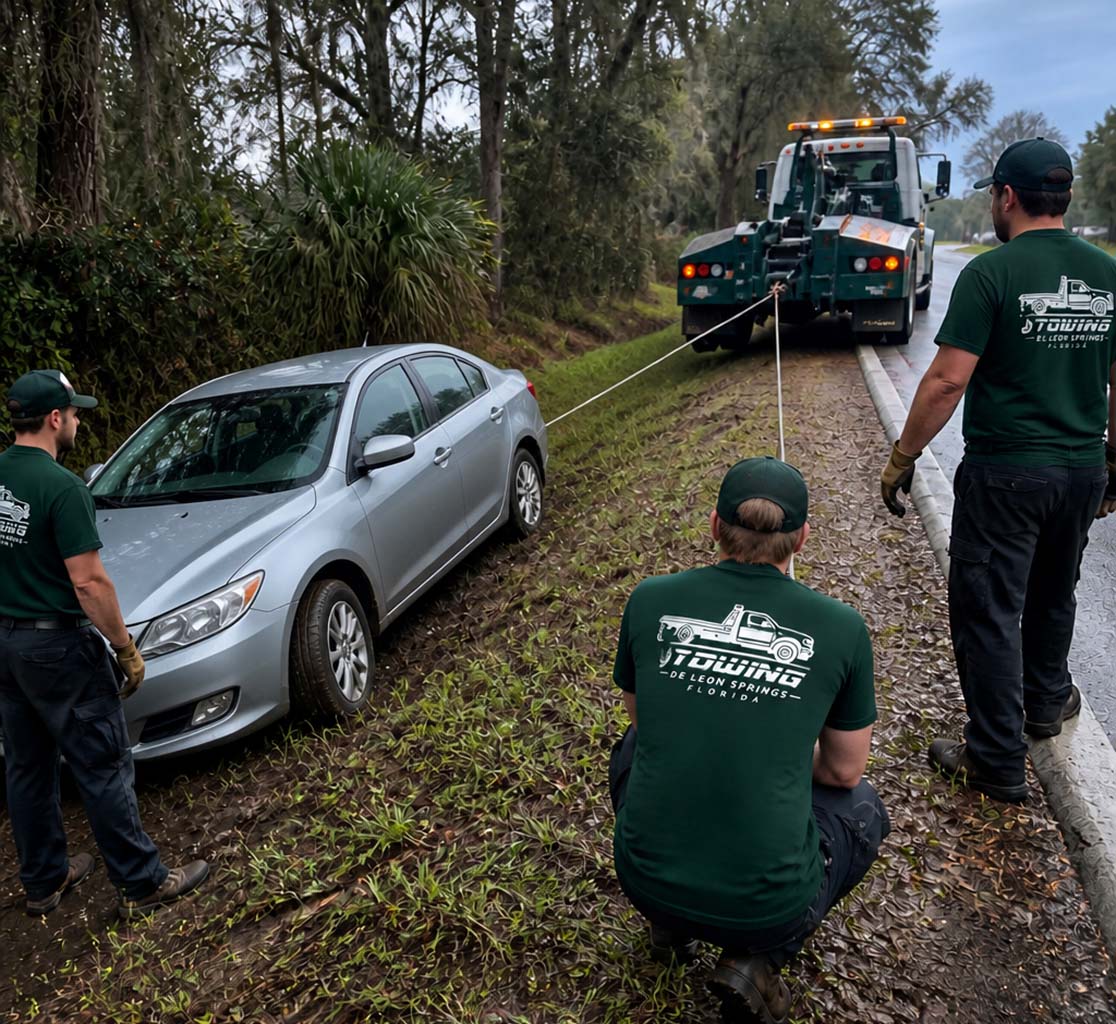
This is where the kind of tow matters. A flatbed carries a wrecked or non-rolling car completely off its wheels, which is the safe choice when the drivetrain, alignment, or suspension may be hurt, and for all-wheel-drive or low-clearance vehicles. Emergency towing focuses on getting a blocking or unsafe vehicle off a live road quickly. If you are not sure which you need, describe the damage to the dispatcher at De Leon Springs Towing and let the operator make the call.
Florida Crash Questions West Volusia Drivers Ask
Do I have to call the police after a minor accident in Florida?
You must report a crash immediately if it caused injury, death, or apparent property damage above the threshold Florida sets in law, and even moderate bumper damage on a modern car can cross that line. Even for smaller bumps, an officer's report protects you if the other driver's account changes later. When you are in doubt, call.
Can I move my car after a crash, or do I have to leave it where it stopped?
Florida law actually tells you to move a drivable car out of the travel lanes if it is blocking traffic, as long as it is safe to do so. Take photos of where the vehicles ended up first if you can, then clear the road. Leaving cars in live lanes on US-17 or I-4 invites a second collision.
What information do I have to give the other driver?
Your name, address, and vehicle registration number, and you must show your driver license on request, to the other driver, to anyone whose property was damaged, and to any officer at the scene. Get the same details back from them, along with insurance information and a photo of their plate.
My car still runs after the accident. Should I drive it home?
Not until you have checked for leaking fluid, a deployed airbag, a pull in the steering, or tire and suspension damage. Any of those means a tow is the safer choice, and a flatbed is best when the car cannot roll safely or should not be driven. A short drive home can quietly turn a fixable car into a total loss.
Florida Statutes via the Florida Senate: 316.061 (duty to stop; damage crashes), 316.062 (duty to give information and render aid), 316.065 (crash reporting), 316.126 (Move Over law).